
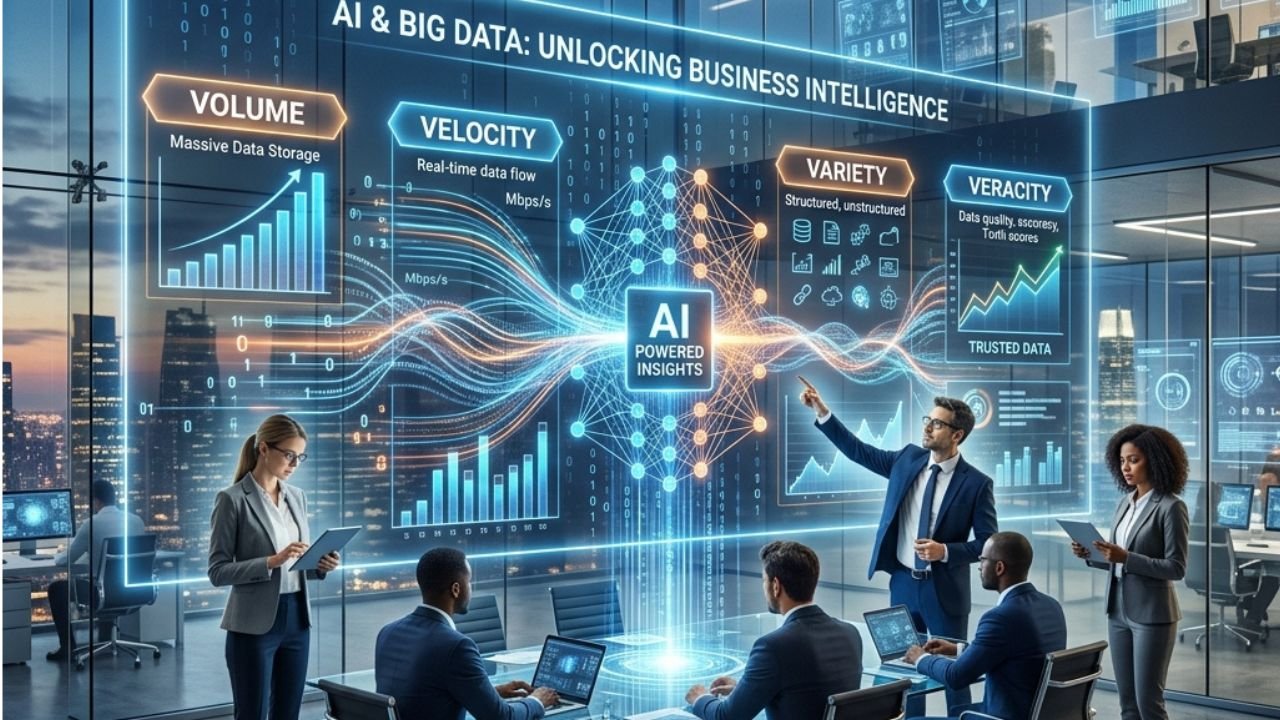
AI and Big Data work together to transform raw data into actionable business intelligence. By combining machine learning algorithms with large-scale datasets, organizations can predict demand, personalize customer experiences, detect fraud, and optimize operations—giving early adopters a measurable competitive edge.
Every day, the world generates approximately 2.5 quintillion bytes of data. That number is growing fast—and most businesses are only scratching the surface of what that data can tell them. The real challenge has never been collecting data. It’s knowing what to do with it.
Artificial intelligence changes that equation entirely. By pairing AI’s analytical power with the depth and scale of Big Data, organizations can move beyond historical reporting and into genuine business intelligence—the kind that drives proactive decisions, not reactive ones.
This post unpacks how AI and Big Data work together, where these technologies are delivering the most value, and how your organization can start building a smarter, data-driven operation.
What Is Big Data—and What Makes It “Big”?
Big Data refers to datasets so large, complex, or fast-moving that traditional data processing tools struggle to handle them. Researchers and practitioners typically describe Big Data through four dimensions:
- Volume: The sheer quantity of data generated—from transactions, sensors, social media, and more.
- Velocity: The speed at which new data is created and must be processed.
- Variety: The range of data types, including structured (spreadsheets, databases) and unstructured (images, video, text).
- Veracity: The reliability and accuracy of the data itself.
These four factors create both the opportunity and the challenge. Rich, real-time data enables sharper insights—but only if you have the tools to process it effectively.
What Is Artificial Intelligence in a Business Context?
Artificial intelligence encompasses a range of technologies that enable machines to perform tasks that typically require human intelligence. Within business intelligence, three capabilities stand out:
- Machine learning (ML): Algorithms that learn from historical data to identify patterns and make predictions without being explicitly programmed.
- Deep learning: A subset of ML that uses neural networks to process complex, unstructured data like images and natural language.
- Predictive analytics: The use of statistical models and ML to forecast future outcomes based on existing data.
Together, these technologies give businesses the ability to analyze data at a scale and speed that no human team could match.
How AI and Big Data Work Together to Generate Business Intelligence
AI algorithms require large volumes of data to train effectively. Big Data provides the raw material; AI provides the analytical engine. The combination unlocks capabilities that neither technology could achieve alone.
How do AI algorithms extract actionable insights from large datasets?
Traditional analytics tools answer questions you already know to ask. AI goes further—it surfaces patterns, correlations, and anomalies in data that humans might never think to look for. For example, an ML model trained on customer purchase history might identify subtle behavioral signals that precede churn, weeks before a customer cancels.
What does real-time data processing enable for business decision-making?
Real-time AI processing allows organizations to act on data as it arrives. A logistics company, for instance, can reroute deliveries dynamically based on live traffic and weather data. A financial institution can flag suspicious transactions in milliseconds. The shift from batch processing to real-time analysis compresses the gap between insight and action—often the most valuable competitive advantage a business can have.
How does AI improve pattern recognition and predictive modeling?
Deep learning models excel at finding non-obvious patterns within high-dimensional data. This makes them particularly effective for tasks like demand forecasting, image-based quality control, and natural language processing—use cases where traditional rule-based systems fall short.
Key Business Intelligence Applications of AI and Big Data
Predictive analytics for demand forecasting and inventory management
Retailers, manufacturers, and logistics companies use AI-powered forecasting to anticipate demand shifts before they happen. According to McKinsey, AI-driven demand forecasting can reduce inventory errors by up to 50% and cut supply chain costs by 5–10%. The result: less waste, fewer stockouts, and better margin management.
Customer behavior analysis and personalization
AI models built on customer data can segment audiences with far greater precision than demographic variables alone. Netflix, Amazon, and Spotify have demonstrated the commercial value of recommendation engines—but the same principles apply to B2B businesses, healthcare providers, and financial services. Personalization at scale is now a realistic goal for any organization with sufficient data infrastructure.
Fraud detection and risk management
Financial institutions and insurers were among the first industries to apply AI to risk management. Machine learning models can analyze thousands of variables simultaneously to detect fraudulent transactions in real time—far outperforming rule-based systems that rely on static thresholds. According to PwC, AI-powered fraud detection reduces false positives by up to 80%, minimizing disruption to legitimate customers.
Market trend analysis and competitive intelligence
AI tools can monitor competitor pricing, product launches, and consumer sentiment at a scale that would require entire research departments to replicate manually. Natural language processing enables businesses to extract signal from unstructured sources—news articles, social media, customer reviews—and build a continuously updated picture of the competitive landscape.
Operational efficiency and cost optimization
From energy usage to workforce scheduling, AI helps businesses identify inefficiencies that are invisible in aggregated data. Predictive maintenance alone—using sensor data to anticipate equipment failure—can reduce downtime by 30–50%, according to Deloitte.
Industry-Specific Use Cases for AI and Big Data
Healthcare: patient diagnosis prediction and drug discovery
AI models trained on medical imaging data can detect conditions like diabetic retinopathy and certain cancers with accuracy comparable to specialist physicians. On the research side, AI platforms like DeepMind’s AlphaFold have accelerated protein structure prediction—a breakthrough with profound implications for drug discovery.
Retail: customer segmentation and recommendation engines
Retailers use AI to build dynamic customer segments that update in real time as behavior changes. Recommendation engines powered by collaborative filtering and deep learning drive a significant share of e-commerce revenue—Amazon attributes approximately 35% of its revenue to its recommendation system.
Finance: algorithmic trading and credit risk assessment
Algorithmic trading systems process market data at millisecond speeds, executing trades based on patterns identified by ML models. In credit risk assessment, AI models evaluate thousands of data points per applicant, enabling faster decisions and more nuanced risk scoring than traditional credit bureau methods.
Manufacturing: predictive maintenance and supply chain optimization
Industrial manufacturers embed sensors across equipment and production lines, feeding data into AI systems that predict failure windows, optimize maintenance schedules, and reduce unplanned downtime. When applied to the supply chain, these systems can model the downstream effects of disruptions—giving operations teams the lead time to adjust.
What Are the Main Challenges of Implementing AI and Big Data?
Data quality and integration issues
AI models are only as good as the data they’re trained on. Fragmented data silos, inconsistent formats, and poor data governance undermine model performance. Before deploying AI, organizations need a clear data quality framework and robust integration architecture.
Privacy, security, and regulatory compliance
As data collection expands, so does regulatory scrutiny. GDPR in Europe, CCPA in California, and sector-specific regulations like HIPAA govern how data can be collected, stored, and used. Non-compliance carries significant financial and reputational risk. Privacy-by-design—building data protection into architecture from the start—is now standard practice for responsible organizations.
Skills gap and talent acquisition
Data scientists, ML engineers, and AI architects remain in short supply relative to demand. Organizations that rely solely on external hiring will struggle to build durable AI capabilities. Investing in internal upskilling programs, alongside strategic recruitment, is a more sustainable approach.
Implementation costs and ROI measurement
Enterprise AI projects require meaningful upfront investment in infrastructure, talent, and tooling. ROI can be difficult to quantify, particularly in the early stages. Establishing clear KPIs before implementation—and tying AI initiatives to specific business outcomes—is essential for maintaining executive buy-in.
Best Practices for Implementing AI and Big Data in Your Organization
- Define clear business objectives first. AI initiatives without a defined problem to solve tend to stall. Start with a specific, measurable outcome—reduced churn, improved forecast accuracy, lower maintenance costs—and work backward to the data and models required.
- Invest in data infrastructure and quality governance. A unified data platform, consistent taxonomies, and clear ownership of data assets are prerequisites for effective AI deployment.
- Build cross-functional teams. The most effective AI implementations bring together data scientists, domain experts, and business stakeholders. Technical sophistication alone doesn’t produce business value.
- Start with pilot projects. Proving value at small scale before committing to enterprise-wide rollout reduces risk and builds organizational confidence in the technology.
- Monitor, evaluate, and iterate. AI models degrade over time as the real world changes. Continuous monitoring and regular retraining are non-negotiable for sustained performance.
What Does the Future of AI and Big Data Look Like for Businesses?
Several emerging trends will shape how organizations use AI and Big Data over the next five years:
- Edge computing: Processing data closer to the source—on devices, in factories, at the point of care—reduces latency and enables AI applications where cloud connectivity is limited.
- Autonomous systems: Advances in reinforcement learning are moving AI from recommendation toward autonomous action in domains like supply chain management and financial trading.
- Ethical AI and responsible data use: Growing regulatory and consumer pressure is accelerating the adoption of explainable AI (XAI) frameworks and bias auditing practices. Organizations that get ahead of this will face fewer compliance risks and stronger stakeholder trust.
- Blockchain integration: Combining AI with distributed ledger technology creates new possibilities for data provenance, audit trails, and secure data sharing across organizational boundaries.
Build Your Intelligence Infrastructure Before Your Competitors Do
AI and Big Data have moved from experimental to essential. Organizations that treat these technologies as strategic infrastructure—not just IT projects—are already pulling ahead in operational efficiency, customer experience, and market responsiveness.
The window for first-mover advantage is still open, but it won’t stay open indefinitely. Start by auditing your current data capabilities and identifying two or three high-value use cases where AI could deliver measurable results. Commission a pilot. Measure it rigorously. Then scale what works.
The data your organization generates every day holds more intelligence than most businesses ever extract from it. The tools to unlock that intelligence exist now. The question is whether your organization will use them.
Frequently Asked Questions
What is the difference between Big Data and AI?
Big Data refers to large, complex datasets that traditional tools cannot efficiently process. Artificial intelligence refers to algorithms and models that learn from data to make predictions or decisions. Big Data provides the training material; AI provides the analytical engine that extracts value from it.
How do small and mid-sized businesses benefit from AI and Big Data?
Cloud-based AI platforms have significantly lowered the cost of entry. Small and mid-sized businesses can now access tools for customer segmentation, demand forecasting, and fraud detection without building enterprise-scale infrastructure. Starting with a focused use case and a cloud-native platform is the most practical path for organizations with limited resources.
How long does it take to implement an AI and Big Data solution?
Timelines vary significantly depending on scope, data readiness, and organizational complexity. A focused pilot project with clean data can produce results in 8–12 weeks. Enterprise-wide deployment typically takes 12–24 months, including infrastructure buildout, model development, and change management.
What industries benefit most from AI and Big Data?
Healthcare, finance, retail, and manufacturing have seen the most mature AI and Big Data adoption. However, the underlying capabilities—predictive analytics, real-time processing, pattern recognition—apply across virtually every sector, including logistics, energy, media, and professional services.
How do organizations ensure responsible and ethical use of AI?
Responsible AI implementation requires clear data governance policies, bias testing of models before deployment, transparency in how AI-generated decisions are made, and ongoing compliance monitoring. Organizations should also designate ownership of AI ethics—whether through a dedicated role or a cross-functional governance committee.